
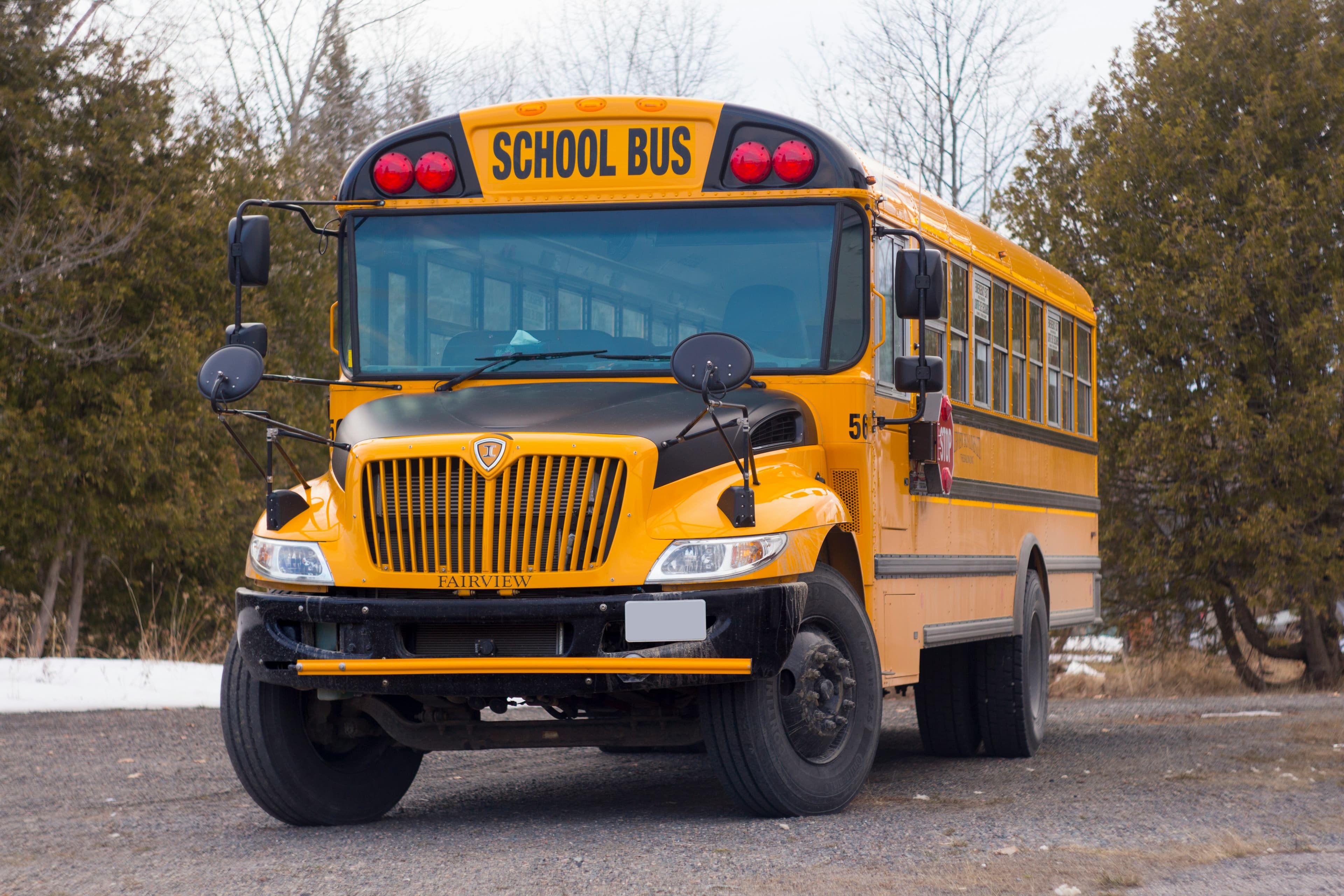
The most dangerous moment in a child's school day isn't on the bus. It's the ten seconds between the curb and the bus door, with a stopped school bus, its red lights flashing, its stop arm extended — and a driver in a passing car who decides not to wait.
A single day's count by the National Association of State Directors of Pupil Transportation Services (NASDPTS) tells the story in one number: an estimated 45.2 million illegal school bus passes happen every year on U.S. roads. That's based on the 2024 NASDPTS one-day survey, extrapolated to a 180-day school year.
After two years of that number getting worse, the 2025 survey finally shows a small reversal. Here's what's in the data, where the violations are happening, and which enforcement strategies are moving the needle.
What the 2024 and 2025 surveys actually measured
NASDPTS runs an annual one-day count. School bus drivers across participating states tally every car that illegally passes their stopped bus during a single day of routes. The 2024 survey, conducted across 35 states, captured:
66,322 illegal passings observed by 98,065 participating drivers in a single day
Extrapolated to 180 school days: ~45.2 million violations per year
A roughly 4% increase from the previous year
The 2025 survey, with broader participation (36 states and DC, 114,239 drivers), recorded 67,258 violations in a single day — and 0.59 violations per bus per day, the first year-over-year decrease in three years.
A 0.59-per-bus number sounds small until you remember it's per bus per day. The average bus stops between 15 and 40 times in a route. Roughly every other day, on the average route, someone is going to break the law in front of a child.
Where it happens
The 2024 NASDPTS data is unusually clear on geometry:
97% of illegal passes occurred on the left side of the bus — the side oncoming traffic approaches.
Just over 3% occurred on the right side — the side students board and exit.
The 3% is the catastrophic 3%. A driver passing a bus on the right is passing it in the lane the children are stepping out of. National Highway Traffic Safety Administration data shows that of the roughly six bus-related pedestrian deaths per year, the largest single category is children struck by passing motorists at or near a bus stop.
Time of day is roughly evenly split between morning and afternoon routes — afternoon edged out morning by only 74 violations in the 2024 count. Whatever's driving the behavior, it's not "morning rush only."
What's working: automated enforcement
The states and districts with the steepest declines in violations share one strategy: cameras on the stop arm, paired with civil-penalty enforcement.
In Pennsylvania, the 2024 statewide Automated School Bus Enforcement (ASBE) annual report showed that districts that adopted camera enforcement saw violation counts drop by 30–50% in the first full year of the program. The pattern is consistent in other states with active programs (notably North Carolina, Maryland, and Texas).
The mechanics matter:
Civil penalty, not criminal. Cameras issue a ticket to the registered owner of the vehicle — like a red-light camera. This sidesteps the "did the officer see it" problem that has historically made stop-arm enforcement unwinnable in court.
Photo evidence. A still and a short video clip, time-stamped, showing the bus's lights and stop arm extended, and the offending vehicle's license plate. Hard to dispute.
Penalty escalation. First offense around $300, second offense around $750, third offense plus court appearance. Districts that telegraph this escalation publicly see behavior change faster.
What enforcement alone can't fix
Enforcement gets the chronic offenders. It doesn't fix the rest of the problem, which is split between two groups:
Drivers who genuinely don't know the law. In some states, you can be ticketed for passing a school bus on the opposite side of a divided highway. In others, you can't. Driver education has not kept up with the variation, and rental-car drivers, recent transplants, and out-of-state commuters get it wrong constantly.
Drivers who know but aren't expecting it. A bus stopped on a road where there hasn't historically been a bus stop, or stopping at a time outside the usual window (a delayed route, a field trip return), catches the population by surprise. The behavior on these is statistically worse than on familiar morning routes.
The second group is the one that better communication can actually address. Districts with route-tracking tools that publicly share when buses are running can reduce the "surprise stop" problem on delayed routes. Combine that with stop-arm cameras for the chronic offenders, and you address both halves of the population.
What districts should do this month
If you're a transportation director, three concrete steps for the next thirty days:
Pull last year's stop-arm violation reports from your drivers. If you don't have a structured way to capture them, fix that this month — drivers should be reporting every visible violation through a single channel, ideally with route, time, and direction. You can't enforce what you don't measure.
Identify your two or three highest-violation stops. They almost always cluster — usually a stop on a 35–45 mph road without a clear sightline to the bus's flashing lights. For those, talk to the city/county DOT about advance warning signage and, for the worst, about relocating the stop.
If your state allows automated enforcement, get a vendor demo. Most stop-arm camera vendors operate on a revenue-share or no-cost-to-district model (they keep a percentage of the civil penalties collected). The economics are usually attractive enough that the bigger barrier is parent/community communication, not procurement.
What good parent communication adds
A subtle thing the 2025 data hinted at: districts with parent-facing bus tracking apps see fewer "surprise stops" — because parents who are watching the bus on a map aren't sending texts to their kid telling them to start walking to the corner early. Kids stay inside until the bus is genuinely close. That reduces the time the bus is sitting at a stop with the door open and a child crossing the road in front of it.
This is one of those second-order effects that's hard to measure directly but plays out in the safety record over time. It's also why parent-side visibility is a safety feature, not just a satisfaction feature. (We wrote more about how parents actually use these tools in the morning anxiety window.)
The longer arc
The 2025 turn from the 2023–2024 worsening trend is genuinely good news. It happened in the same year multiple states expanded camera-enforcement authorization, raised civil penalties, and required driver education on stop-arm rules. The data doesn't isolate any single intervention, but the combination is the closest thing to a controlled experiment we've had at scale, and it points the right direction.
Forty-five million violations a year is too many. The number can fall faster than it has so far — but only if districts, states, and the school-transportation industry treat it as the safety crisis it is, rather than the line item it usually becomes.
For a copy of the model stop-arm reporting workflow our pilot districts use, request a demo — we'll send it whether or not you take a meeting.
Sources: NASDPTS National Stop Arm Violations Survey, PA Automated School Bus Enforcement 2024 Annual Report, NHTSA — Reducing Illegal Passing of School Buses, School Transportation News reporting.